
Let’s be honest, as both an educator and mum of two, I’ve discovered something that might surprise you, the best homemade toddler toys often come from whatever’s already sitting in your kitchen drawer or recycling bin. After years of watching children gravitate toward simple materials over expensive toys, I’m sharing 20 practical, budget-friendly ideas that support genuine development whilst saving your money and sanity. These aren’t perfect Pinterest projects requiring craft store trips, they’re real solutions using items you already have at home.
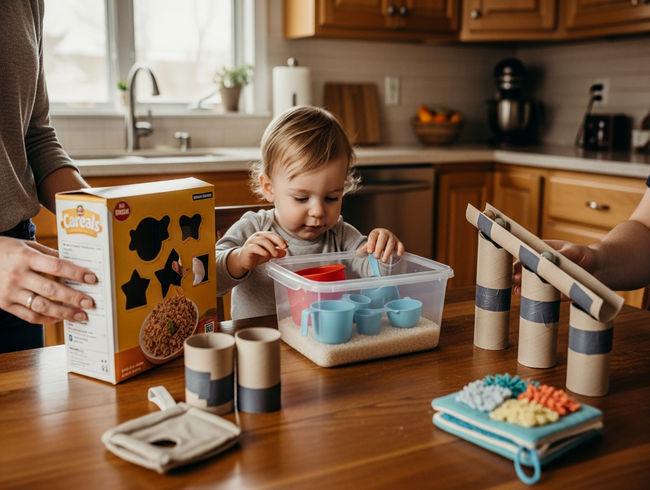
1. Cereal Box Shape Sorters Develop Fine Motor Skills Better Than Store-Bought Versions
Creating customisable shape sorters from empty cereal boxes gives you complete control over difficulty progression, something expensive alternatives can’t match. Simply cut various shaped holes in the top, start with large circles, then progress to squares, triangles, and more complex shapes as your toddler masters each level.
The beauty lies in using everyday kitchen items as the “shapes”—plastic lids, wooden spoons, measuring cups, or wooden blocks all work perfectly. This directly supports the Early Years Learning Framework outcomes for fine motor development, as children manipulate objects through increasingly challenging openings. One mum I know started with holes large enough for tennis balls, then gradually moved to smaller openings for bottle tops over several months. Always ensure cut edges are smooth to prevent scratches during enthusiastic play sessions.
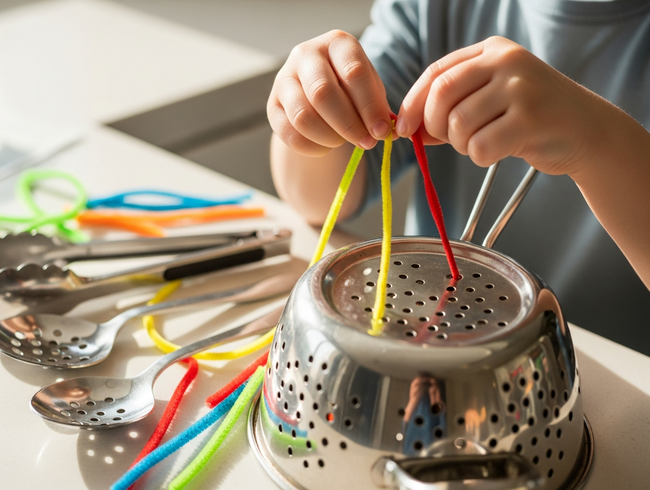
2. Kitchen Utensil Threading Stations Build Concentration and Hand-Eye Coordination
Threading activities naturally extend concentration spans whilst developing the precise hand-eye coordination needed for future writing skills. Transform your kitchen drawer into a threading paradise using colanders, slotted spoons, and kitchen tongs paired with pipe cleaners, shoelaces, or fabric strips.
Start with colander holes and thick shoelaces, then progress to slotted spoon slots with pipe cleaners as dexterity improves. I’ve watched 18-month-olds spend twenty minutes threading a single shoelace through colander holes—that’s exceptional focus development for their age. The developmental benefits of threading activities include bilateral coordination, where both hands work together in different roles, preparing children for complex tasks like tying shoes or using scissors. Speaking of sensory experiences, our next activity takes tactile learning to another level.
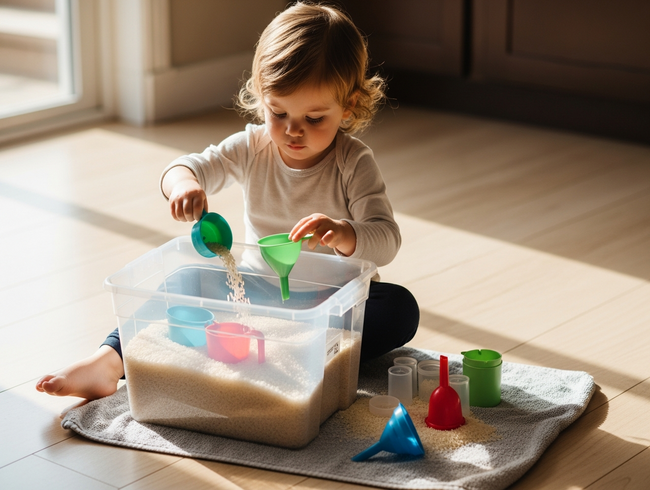
3. Rice and Pasta Sensory Bins Create Calm Focus Whilst Building Pre-Math Skills
Sensory bins using dried rice or pasta provide the regulating input many toddlers need whilst sneaking in early mathematical concepts like measuring, pouring, and volume comparison. Set up a large plastic container with your chosen base material, then add kitchen scoops, measuring cups, funnels, and small containers for endless exploration.
Try hiding magnetic letters in rice for letter recognition games, or add toy cars for a “car wash” experience that combines sensory play with imaginative scenarios. This aligns perfectly with EYLF sensory exploration outcomes, supporting both emotional regulation and cognitive development. A rookie mistake many of us make is worrying about mess—place the bin on an old towel and involve your toddler in cleanup as part of the activity. The sweeping and scooping become additional fine motor practice.
4. Cardboard Tube Marble Runs Engage Multiple Ages Simultaneously
When you’re managing multiple children, activities that captivate different age groups simultaneously become absolute gold. Tape toilet paper tubes to walls or furniture at various angles, creating ball runs that let toddlers experience cause-and-effect whilst older siblings design increasingly complex tracks.
Toddlers delight in simply dropping balls and watching them roll, developing hand-eye coordination and understanding gravity. Meanwhile, four-year-olds problem-solve tube angles and predict ball paths, engaging in critical thinking and spatial reasoning. This multi-level engagement supports creative thinking outcomes from the Early Years Learning Framework. Important safety note: ensure balls or cars used are larger than toilet paper tube openings to prevent choking hazards during enthusiastic play.
5. Furniture Obstacle Courses Transform Living Rooms Into Movement Havens
Melbourne’s unpredictable weather makes indoor gross motor activities essential, and furniture obstacle courses cost absolutely nothing whilst providing crucial physical development opportunities. Arrange couch cushions for jumping, chairs for crawling under, and blankets stretched between furniture for balancing challenges.
These courses support EYLF physical development outcomes by strengthening core muscles, improving balance, and developing spatial awareness in familiar environments. Change the course weekly to maintain interest—Monday might feature low crawling challenges, whilst Friday focuses on jumping and balancing. The one thing that saved my sanity during last winter’s lockdowns was realising our lounge room could transform into a gymnasium within five minutes. Now let’s explore how cardboard packaging can spark creativity.
6. Pizza Box Art Easels Encourage Creativity Without the Mess Stress
Transform empty pizza boxes into standing art easels that contain mess whilst encouraging creative expression. Cut the lid partially, fold it back as a support, and use clothespins or clips to hold paper in place. The box bottom catches falling materials, dramatically reducing cleanup stress.
Rotate available materials weekly—crayons, stickers, stamps, or washable markers each offer different creative challenges. This supports creative expression outcomes by providing regular opportunities for artistic exploration without overwhelming parents with mess management. Set up the easel in the kitchen whilst you’re cooking dinner, creating parallel activity time that works for busy family schedules. The contained workspace means you can genuinely relax whilst your toddler creates their masterpieces.
7. Sock Sorting and Matching Games Build Pattern Recognition Naturally
Use your family’s inevitable collection of mismatched socks for powerful cognitive development activities that cost nothing and actually help with laundry organisation. Start with simple colour matching, progress to size sorting, then advance to complex pattern recognition challenges.
This progression naturally develops early mathematical thinking and classification skills essential for future learning. I love watching toddlers discover that striped socks can be grouped by stripe width, colour combinations, or sock length—they’re developing multiple classification systems simultaneously. The cognitive benefits extend beyond mathematics into logical thinking patterns that support reading comprehension and scientific reasoning. Store sorted socks in clear containers, making this activity available whenever you need twenty minutes of focused quiet time.
8. Water Transfer Stations Develop Life Skills Whilst Providing Sensory Input
Set up bathroom or kitchen water play using various containers, turkey basters, measuring cups, and small pitchers for endless pouring and transferring activities. This provides the sensory input many toddlers crave whilst developing practical life skills like pouring drinks or watering plants.
Add food colouring or bubbles occasionally for extra sensory interest, but plain water holds attention surprisingly well. Water play supports independence development and concentration skills, both crucial Early Years Learning Framework outcomes. Safety considerations include constant supervision and non-slip mats, but the developmental benefits far outweigh setup efforts. Children naturally progress from random pouring to precise transfers, building the hand control needed for future self-care tasks.
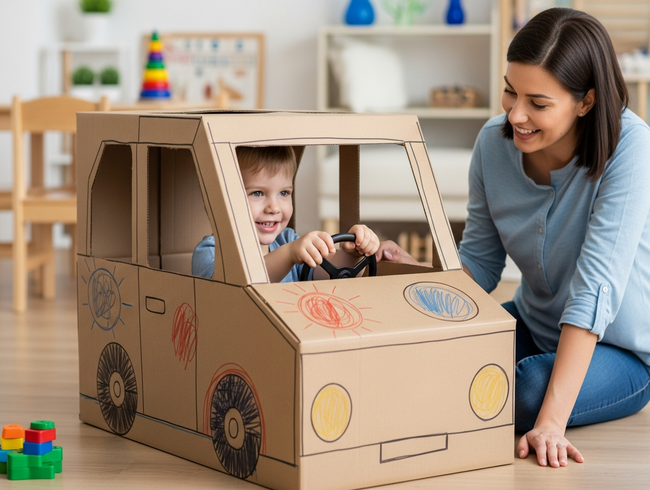
9. Cardboard Box Vehicles Spark Imaginative Play That Lasts for Months
Large cardboard boxes transform into vehicles that evolve with your toddler’s imagination, providing exceptional value from free materials. Cut holes for windows and doors, but leave decoration and modification to your child’s creativity—this ensures ongoing engagement as interests change.
One box might start as a car, transform into a house by week two, become a rocket ship by month three, then return to being a car with completely different significance. This flexibility supports dramatic play outcomes and creative expression, allowing children to revisit and reinterpret the same materials through different developmental lenses. Involving children in decoration decisions builds ownership and extends play value far beyond initial novelty.
10. Masking Tape Road Systems Create Endless Play Scenarios
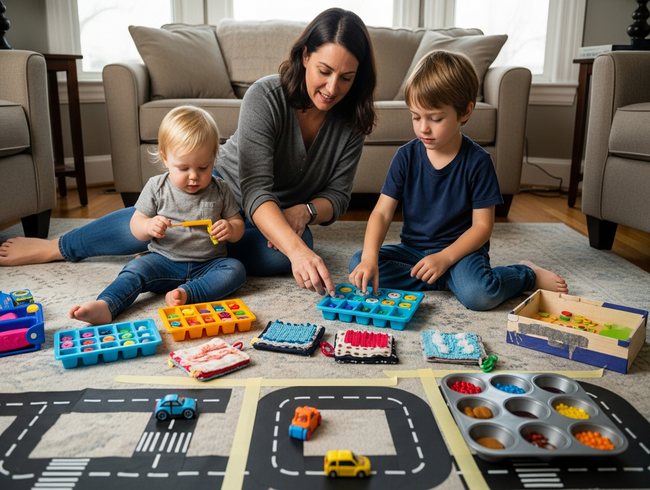
Painter’s tape on floors creates road systems, hopscotch courts, parking lots, or abstract patterns that support both imaginative play and gross motor development. The temporary nature means you can redesign weekly without permanent changes to your home.
Add toy cars for traffic scenarios, practice hopping for physical challenges, or create letter shapes for early literacy connections. This versatility supports spatial reasoning development whilst providing structured gross motor activities during weather-confined days. The tape removes cleanly without damaging floors, making this practical for rental properties or homes where permanent modifications aren’t possible. Parents love the easy cleanup, children love the customisation possibilities.
11. Button and Bead Sorting Trays Build Mathematical Thinking Through Play
Insider Tip: Use ice cube trays or muffin tins with large buttons, pompoms, or wooden beads to create sorting activities that develop early mathematical thinking through hands-on exploration. Start with simple colour sorting, progress to size differentiation, then combine both criteria for complex classification challenges.
This naturally develops counting skills, pattern recognition, and logical thinking essential for future mathematics learning. Watch your toddler discover they can sort the same materials multiple ways—red buttons versus blue buttons, then large buttons versus small buttons, then red large buttons versus red small buttons. Important safety note: ensure all materials are larger than your child’s throat to prevent choking hazards, and always supervise play sessions. These skills directly transfer to reading comprehension and scientific thinking.
12. Laundry Basket Ball Pits Provide Sensory Regulation on Demand
Fill large laundry baskets with plastic balls, soft toys, or even balled-up socks for instant sensory regulation when toddlers need calming input. This contained sensory experience provides the deep pressure many children crave whilst developing body awareness and spatial understanding.
Rotate basket contents weekly—Monday might feature textured fabric squares, Wednesday could include different sized balls, and Friday might showcase various soft toys. This variety maintains interest whilst addressing different sensory needs. The portable nature means you can move calming sensory experiences to any room where they’re needed most. Perfect for those overwhelming afternoon moments when everyone needs a reset.
13. Cardboard Tube Binoculars Encourage Outdoor Exploration
Tape two toilet paper tubes together and attach string to create “binoculars” that transform ordinary backyard exploration into exciting discovery adventures. These simple tools encourage close observation of nature whilst developing scientific thinking skills.
Children naturally become more observant when using their special binoculars, noticing details they’d typically overlook. This supports inquiry-based learning outcomes by encouraging questions about what they observe. Decorate with stickers or paint for ownership, but the real magic happens during exploration sessions. Watch your toddler’s vocabulary expand as they describe leaf textures, cloud shapes, or bird behaviours they discover through focused observation.
14. Kitchen Container Drum Sets Release Energy Constructively
Turn various sized pots, pans, and plastic containers upside down with wooden spoons for instant drum sets that channel energy whilst developing rhythm and coordination. Different container sizes create different tones, introducing basic musical concepts through experiential learning.
This activity supports both gross motor development and creative expression whilst providing an outlet for high-energy moments. Set up drumming sessions during natural energy peaks—after breakfast or before dinner—to work with your toddler’s natural rhythms rather than against them. The one thing that saved my sanity during school holidays was realising loud, energetic play could be scheduled and contained rather than suppressed.
15. Fabric Scrap Texture Books Build Sensory Vocabulary
Collect fabric scraps with different textures—velvet, corduroy, satin, burlap—and staple or sew them into simple books that develop tactile discrimination whilst building descriptive vocabulary. Each page offers different sensory input that supports neural development.
Read these texture books together, introducing vocabulary like “rough,” “smooth,” “bumpy,” or “silky” whilst children explore each texture. This multi-sensory approach supports language development outcomes by connecting physical sensations with descriptive words. Children with sensory processing differences particularly benefit from regular texture exploration in controlled, positive contexts.
16. Plastic Bottle Bowling Sets Develop Gross Motor Skills and Turn-Taking
Fill empty plastic bottles with varying amounts of rice or water to create bowling pins with different weights and sounds. Use a soft ball for bowling, creating opportunities for gross motor practice whilst learning about force, distance, and cause-and-effect relationships.
This activity naturally teaches turn-taking and patience whilst developing hand-eye coordination and spatial awareness. Adjust pin spacing and ball size based on your toddler’s developmental stage—closer pins and larger balls for beginners, increased challenge as skills develop. The social aspects support emotional development outcomes whilst physical play strengthens core stability.
17. Contact Paper Sticky Walls Create Process-Focused Art Experiences
Tape contact paper sticky-side-out to walls at toddler height, providing surfaces where natural materials like leaves, feathers, or tissue paper squares stick without glue mess. This process-focused art supports creativity without predetermined outcomes.
Refresh materials regularly—autumn leaves in October, tissue paper squares in November, cotton balls in December. The changing materials maintain interest whilst seasonal connections develop environmental awareness. Children experiment with placement, removal, and repositioning, developing decision-making skills and creative confidence through open-ended exploration.
18. Muffin Tin Colour Sorting Games Develop Classification Skills
Use muffin tins with coloured paper in each cup for sorting activities using everyday items like buttons, blocks, or even snack foods. This develops classification skills whilst providing structured activity during busy cooking times.
Progression from simple colour sorting to complex multi-attribute sorting (red AND round, blue AND square) builds logical thinking essential for mathematics and reading comprehension. Let’s be honest, we don’t always have time for elaborate setups—these simple tins work perfectly whilst you’re preparing dinner, creating parallel activity time that works for real family schedules.
19. Cardboard Tube Building Sets Encourage Engineering Thinking
Collect various sized cardboard tubes and cut slots for connecting into building sets that encourage spatial reasoning and engineering thinking. Unlike expensive building toys, these can be modified, cut, and redesigned to match your child’s developmental level.
Children naturally experiment with balance, connection methods, and structural stability whilst building towers, bridges, or abstract sculptures. This hands-on engineering supports problem-solving outcomes whilst developing persistence when structures fall down. The modifiable nature means activities can grow with your child’s abilities rather than becoming too easy or frustratingly difficult.
20. Pillowcase Dress-Up Collections Spark Imaginative Play Stories
Cut holes in old pillowcases for instant dress-up costumes that spark imaginative play without expensive costume investments. Simple modifications create superhero capes, princess dresses, or character costumes limited only by your toddler’s imagination.
This dramatic play supports language development and social-emotional learning as children explore different roles and scenarios. Store various pillowcase costumes in a dedicated dress-up basket, making imaginative play readily available when needed. The simple nature means children focus on creative storytelling rather than complex costume mechanics.
Supporting Your Child’s Development Through Everyday Materials
As both an educator and mum, I’ve learned that the most powerful learning happens through materials children can manipulate, modify, and make their own. These homemade toys support genuine development because they grow with your child’s abilities and interests, something expensive alternatives rarely achieve.
The Early Years Learning Framework emphasises play-based learning that connects to children’s interests and experiences. These simple activities honour that principle whilst working within real family constraints of time, budget, and space. A rookie mistake many of us make is thinking educational toys must be expensive or elaborate—sometimes the cardboard box provides more learning opportunities than whatever came inside it.
Remember, the goal isn’t Pinterest-perfect activities but genuine engagement that supports your child’s natural development patterns. Start with one or two ideas that match your current household items and your toddler’s interests, then expand as you discover what captures their attention most effectively.
To learn more about our play-based Early Years Learning Framework approach and how we support children’s natural development through hands-on exploration, Book a Tour at True Maple Bilingual Early Learning Centre. Contact us at 03 7504 3524 or to discover how our inquiry-based curriculum builds confident, curious learners through the same developmentally-appropriate principles you’re implementing at home.