
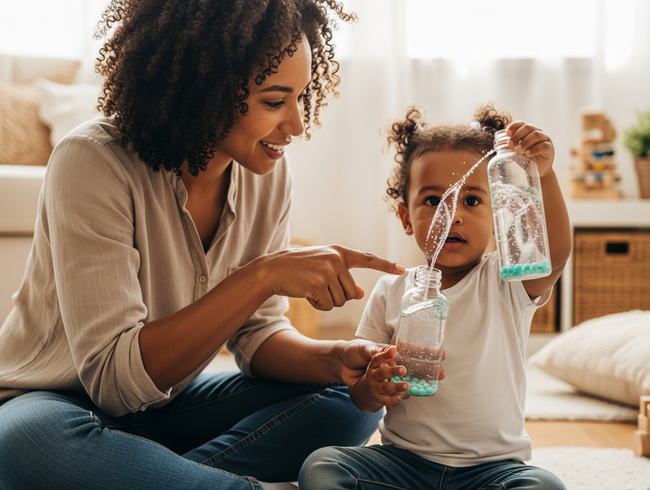
Let’s be real for a second: the moment someone mentions sensory play ideas, your mind probably goes straight to glitter embedded in the rug for three years, or kinetic sand that somehow migrated into your bedsheets.
I’m in the toddler room every day, so trust me, I’ve learned the hard way that “Pinterest perfection” usually ends in tears—mostly mine. But here is the thing: we often avoid sensory play because we equate it with chaos. We think if it isn’t messy, it’s not working.
But as educators, we don’t use sensory play just to make art. We use it for nervous system regulation. When a toddler is melting down, the heavy sensation of squishing dough or the repetitive sound of pouring water can actually reset their brain. It’s a vital part of the Early Years Learning Framework (Outcome 4), but it doesn’t require a hazmat suit.
If you hate the cleanup, that is completely valid. You’re already juggling a million things. That’s why this guide isn’t about making a mess; it’s about containment.
The True Maple Difference: Inquiry-Based Play
At True Maple, we approach sensory play a little differently. We don’t just set up activities to keep children busy; we create “Inquiry-Based” moments that build curiosity without destroying the classroom (or your lounge room).
We build confidence by containing the mess, not restricting the fun. Whether it’s in our toddler room or our bilingual program, we focus on the process, not the product. We know that valid learning happens just as effectively with a ziplock bag as it does with an exploding volcano. The goal is to engage their senses to help them self-regulate and explore.
Here is how we do it—low mess, high engagement, and zero glitter required.
Babies: The Containment Phase
Focus: Exploration without ingestion (or carpet stains).
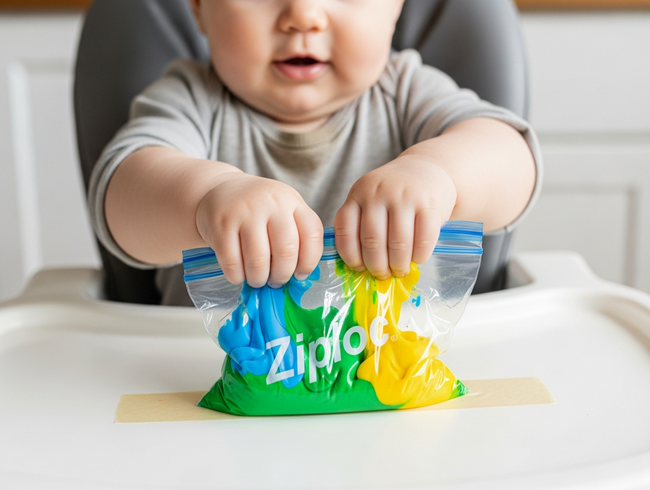
1. Squish Paint in Ziplock Bags
Tape a ziplock bag to the high chair tray or floor. Inside, put two blobs of different coloured paint. Let your baby smash, mix, and trace lines with their fingers.
- The Sensory Detail: The cool, yielding slide of the paint moving under the plastic.
- Prep Time: 2 minutes.
- Sibling Hack: Give the older sibling a cotton bud (Q-tip) to “write” letters or draw shapes on the outside of the bag.
2. Rescue the Taped Toys
Stick some of their plastic animals or rattle toys to a baking tray using masking tape. Their job is simply to pull them off.
- The Sensory Detail: The sticky resistance and the sharp rip sound as the tape comes loose.
- Prep Time: 3 minutes.
- Sibling Hack: Challenge your older child to tape them back down using the smallest amount of tape possible (fine motor workout!).
3. Roll Sensory Bottles
Fill empty clear water bottles with water, a drop of food colouring, and perhaps a few dry pasta spirals or beads. Glue the lid shut (crucial step!).
- The Sensory Detail: The mesmerising swirl of the water and the rhythmic clack-clack of the items hitting the plastic.
- Prep Time: 5 minutes.
- Sibling Hack: Ask the older sibling to make a “slow” bottle (add clear glue or oil) and a “fast” bottle (just water) and race them.
4. Explore a Water Blob
Fill a large ziplock bag with water (about halfway) and maybe add some glitter or small foam shapes if you’re feeling fancy. Duct tape all four sides securely to the floor.
- The Sensory Detail: The wobbly, unstable surface that feels like walking on a waterbed.
- Prep Time: 4 minutes.
- Sibling Hack: Treat it like a “pond”—the older sibling has to jump over it without touching the water.
5. Shred the Fabric Box
Stuff an empty tissue box with scraps of fabric—velvet, silk, denim, wool. Let them pull everything out.
- The Sensory Detail: The friction of rough wool versus the slippery escape of the silk.
- Prep Time: 2 minutes.
- Sibling Hack: The older sibling has to sort the pulled fabric by colour or texture (soft vs. scratchy).
Toddlers: The Tantrum Diffusion Phase
Focus: Heavy work and texture differences to help emotional regulation.
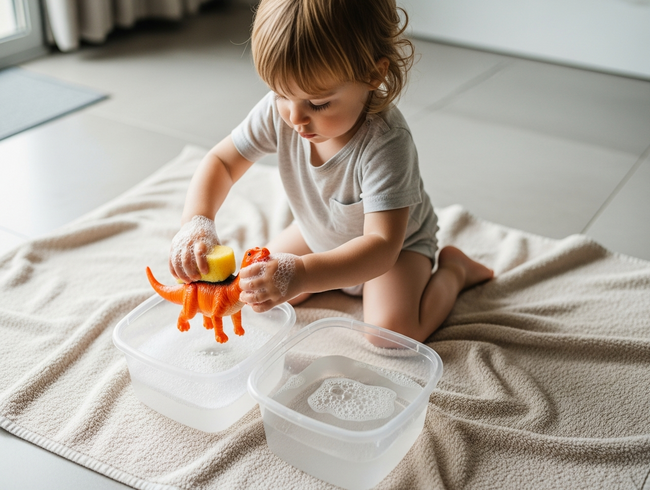
6. Wash the Toys (Station)
Lay a towel on the kitchen floor. Fill one plastic tub with soapy water and one with clean water. Throw in the Duplo or plastic dinosaurs and a sponge.
- The Sensory Detail: The slippery, foaming bubbles sliding over their hands and the squeak of clean plastic.
- Prep Time: 3 minutes.
- Sibling Hack: Assign the older sibling the role of “Drying Manager” with a tea towel.
7. Stomp Bubble Wrap
Tape a sheet of large-bubble packaging wrap to the floor. This is excellent “heavy work” for a toddler who is feeling frustrated or energetic.
- The Sensory Detail: The satisfying, loud POP that vibrates up through their feet.
- Prep Time: 1 minute.
- Sibling Hack: See who can pop all the bubbles in their section the fastest (use a timer!).
8. Rescue Frozen Animals
Freeze small plastic toys in a muffin tray with water. Pop them out into a baking dish and give your toddler a squeeze bottle of warm water to melt the ice.
- The Sensory Detail: The stinging cold of the ice contrasted with the warm water trickling over fingers.
- Prep Time: 1 minute (plus freezing time).
- Sibling Hack: Give the older child salt to sprinkle on the ice and explain how it melts the ice faster (science in action!).
9. Crush Cereal “Sand”
Put stale cornflakes or crackers in a mortar and pestle or a sturdy bowl with a masher. Let them crush it into dust. It’s destruction that is allowed!
- The Sensory Detail: The loud crunch and the transformation from solid flake to gritty dust.
- Prep Time: 1 minute.
- Sibling Hack: Use the “sand” as a base for a construction site with mini diggers.
10. Paint with Water
Take a bucket of water and a paintbrush outside. Let them “paint” the brick wall, the fence, or the pavement.
- The Sensory Detail: The visual magic of the dark, wet stroke appearing and then slowly fading away as it dries.
- Prep Time: 1 minute.
- Sibling Hack: Play Pictionary—the older child draws a shape, and the parent has to guess it before it evaporates.
Preschoolers: The Little Scientists
Focus: Inquiry, cause-and-effect, and problem-solving.
11. Mix Oobleck (The Non-Newtonian Fluid)
Mix 2 cups of cornflour with 1 cup of water in a tray. It’s hard when you punch it, but liquid when you pour it. It’s the easiest cleanup because when it dries, it just sweeps up as powder.
- The Sensory Detail: The confusing sensation of a solid turning into a dripping liquid in your palm.
- Prep Time: 3 minutes.
- Sibling Hack: Challenge them to roll a ball quickly. If they stop moving their hands, it melts!
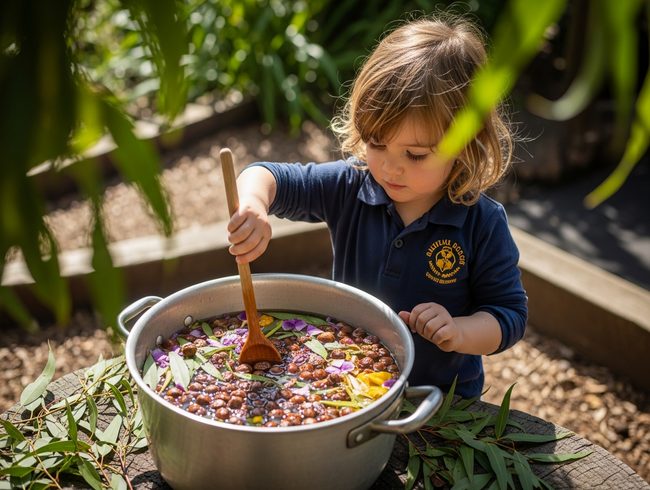
12. Brew Nature Soup
Go for a walk and collect gum nuts, leaves, and flowers. Put them in a large pot of water with a ladle and “cook.”
- The Sensory Detail: The earthy smell of wet eucalyptus and dirt mixing with water.
- Prep Time: 0 minutes (part of the walk).
- Sibling Hack: The older sibling writes the “recipe” or menu for the soup.
13. Create Fizzy Potions
Put a layer of bi-carb soda in a tray. Give them a dropper or spoon with vinegar (dyed with food colouring if you’re brave).
- The Sensory Detail: The aggressive hiss and bubbling foam rising up.
- Prep Time: 4 minutes.
- Sibling Hack: Ask the older sibling to predict which colour explosion will be the biggest.
14. Build with Shaving Cream
Squirt shaving cream into a baking tray. Use Duplo blocks to build towers, using the foam as “cement.”
- The Sensory Detail: The airy, cloud-like fluff that smells like dad’s bathroom.
- Prep Time: 1 minute.
- Sibling Hack: Use a ruler or spatula to “squeegee” the tray clean—extremely satisfying for perfectionist tendencies.
15. Sort the “Sticky” Wall
Put a large piece of contact paper (sticky side out) on the wall or a glass door. Provide light objects like pompoms, feathers, or tissue paper to stick on.
- The Sensory Detail: The gentle tug as their finger momentarily sticks to the glue surface.
- Prep Time: 3 minutes.
- Sibling Hack: Create a mosaic art piece or a pattern that the younger sibling has to copy.
The Insider Tip: The True Maple ‘Art of Learning’ Twist
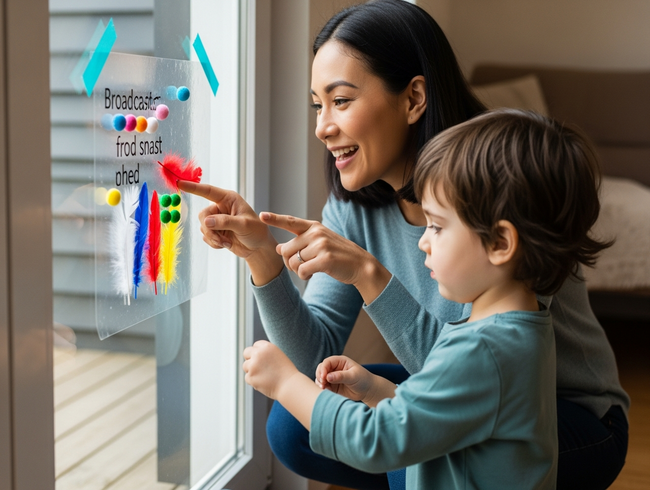
One secret from the toddler room is that you don’t need to be a teacher during these moments. You don’t need to quiz them on colours or shapes. We use a strategy called “Broadcasting.”
You simply narrate what is happening. “Oh, that water is cold.” “Listen to that crunch.” “It feels sticky.”
At True Maple, we use these sensory moments as a bridge for our bilingual program. When a child is deep in play, their brain is wide open to new vocabulary. We might introduce the Mandarin word for “wet” or “blue” while they are washing toys. It takes the pressure off you to “teach” and allows you to just be a broadcaster of vocabulary. You are building their language skills without a single flashcard.
Conclusion
Here is the bottom line: a plastic tub with two inches of water and a few cups counts as high-quality early education.
Don’t let the fear of mess stop you from giving your child these regulating experiences. A 2-minute setup that gives you 20 minutes of peace (and them a calm nervous system) is a win for everyone. We are looking for connection and regulation here, not a photo for the grandparents.
So, grab a ziplock bag or a baking tray and try just one of these ideas today.
If you’d like to discuss your specific Childcare needs with our experienced team, we invite you to take action. Contact True Maple Bilingual Early Learning Centre today at 03 7504 3524 or to Book a Tour and see how our expert-led approach can support your goals.