
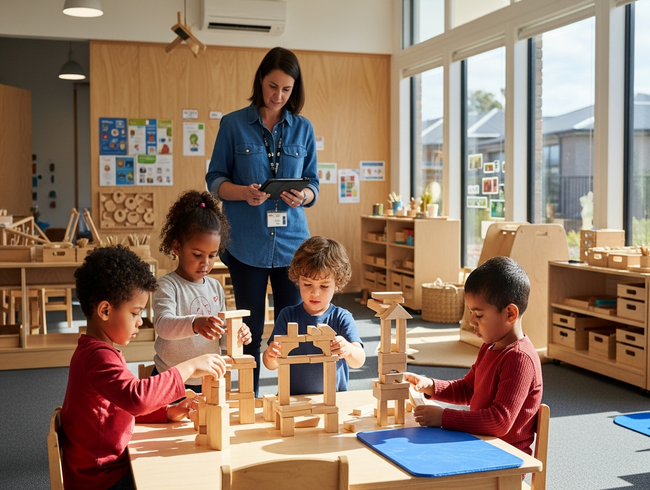
In my 15 years leading early childhood centres, I’ve watched countless anxious parents question whether their child is “just playing” when they should be learning. Here’s what might surprise you: children in high-quality play-based programs consistently outperform their peers in formal academic settings by 20% in long-term educational outcomes.
The pressure on modern parents to provide their children with early academic advantages has never been greater. Every day, I meet families torn between what feels natural – watching their child explore, create, and discover through play – and what society tells them they should prioritise: structured lessons, early literacy drills, and measurable academic milestones. This anxiety is understandable when you’re bombarded with messages about giving your child the “best start” and ensuring they don’t fall behind.
What I’ve learned through extensive research and hands-on experience is that this concern, while well-intentioned, fundamentally misunderstands how young children’s brains actually develop. The science is clear: quality play-based learning programs don’t just match traditional academic approaches – they surpass them in preparing children for lifelong success. When early childhood centres truly master frameworks like the Early Years Learning Framework (EYLF), they create environments where play becomes the most powerful learning tool your child will ever encounter.
The Neuroscience Behind Play-Based Learning: Why Your Child’s Brain Needs Unstructured Exploration
The developing brain of a young child is unlike anything else in nature. Every second, neural connections are forming at a rate of 1,000 per second, creating the foundation for all future learning, behaviour, and emotional regulation. Through my educational background and years of observing children, I’ve witnessed firsthand how play serves as the primary architect of this incredible process.
When children engage in unstructured play, their brains activate what neuroscientists call executive function – the mental skills that include working memory, flexible thinking, and self-control. Consider what happens when a three-year-old decides to build a tower with blocks. They must plan their approach, hold their vision in mind while gathering materials, adapt when blocks don’t balance as expected, and regulate their emotions when the tower inevitably tumbles down. This single play experience strengthens neural pathways that will serve them throughout their educational journey and beyond.
Under the EYLF framework, we recognise this as Outcome 4: Children are Confident and Involved Learners. What appears to be simple play is actually sophisticated brain development in action. I’ve observed children who spend their days in rich play environments develop superior problem-solving abilities, emotional resilience, and creative thinking compared to those in highly structured, adult-directed programs.
One of my favourite examples involves a group of four-year-olds who discovered a puddle after rain. Rather than directing them away from the “mess,” our educators supported their investigation. The children hypothesised about depth, tested floating and sinking with natural materials, and created elaborate storylines about puddle creatures. Months later, these same children demonstrated advanced scientific thinking when introduced to formal concepts about water displacement and buoyancy. Their brains had created robust neural networks through play that made complex learning feel effortless.
Research from the University of Colorado demonstrates that children who engage in high-quality play experiences show increased activity in the prefrontal cortex – the brain region responsible for planning, decision-making, and impulse control. These are the exact skills that predict academic success far better than early reading or mathematics drilling. This understanding transforms how we view every moment of your child’s day, recognising that their most important learning happens through authentic exploration and discovery.
From Sandpit to School Success: How Everyday Play Activities Build Academic Foundations
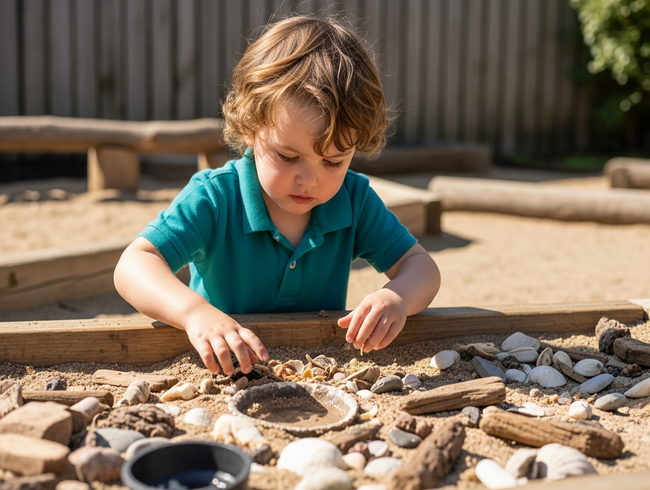
The magic of play-based learning becomes even more apparent when you understand how everyday activities directly build the skills your child needs for academic success. In our sandpit, children aren’t just playing – they’re developing mathematical concepts that will serve as the foundation for complex problem-solving throughout their school years.
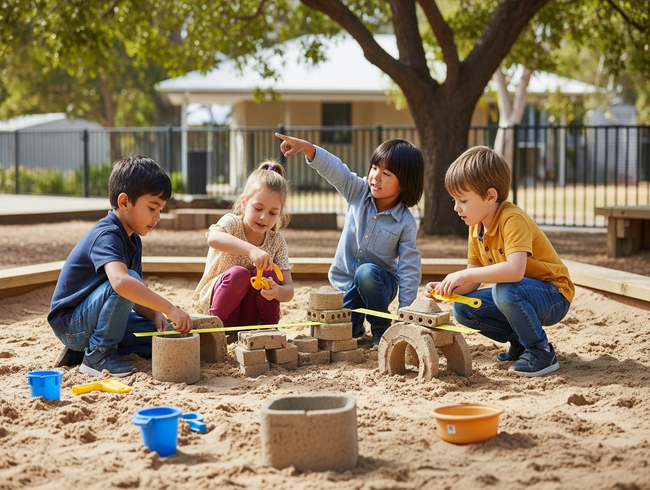
When children fill containers with sand, they’re exploring volume, capacity, and measurement. As they build sandcastles, they investigate structural engineering, spatial relationships, and cause-and-effect principles. The negotiations that naturally arise – “I need the big bucket next” or “Let’s make the moat deeper” – develop language skills, social competence, and collaborative problem-solving abilities. Under EYLF Outcome 5, we recognise these experiences as fundamental to children’s communication and language development, as well as their early mathematical understanding.
I recently documented a remarkable example of this learning in action. A group of children aged three to five became fascinated with creating “roads” in the sandpit for their toy cars. What started as simple track-making evolved into complex discussions about which routes were faster, how to make cars go around corners without falling off, and whether wet or dry sand created better road surfaces. These children were naturally engaging with concepts of physics, geometry, measurement, and hypothesis testing – all while having tremendous fun.
The academic benefits extend far beyond STEM subjects. During dramatic play, children develop literacy skills through storytelling, character development, and narrative structure. I’ve watched four-year-olds create elaborate scenarios in our home corner, assigning roles, developing plot lines, and solving character conflicts. These experiences build the same skills they’ll later use to understand story structure in books, develop writing abilities, and comprehend complex texts.
Research from Cambridge University followed children through primary school and found that those who experienced rich play-based early childhood programs demonstrated superior reading comprehension, mathematical reasoning, and social competence compared to peers from academic-focused programs. Perhaps most significantly, these advantages increased over time rather than diminishing.
“The children who spent their early years playing, creating, and exploring didn’t just match their academically-drilled peers – they consistently outperformed them in creative thinking, problem-solving resilience, and collaborative learning skills.”
What’s particularly compelling is that children from play-based programs showed greater enthusiasm for learning and higher levels of intrinsic motivation. They approached new challenges with curiosity rather than anxiety, having learned through play that learning itself is enjoyable and rewarding. This psychological foundation proves far more valuable than any early academic skill we might try to drill into them.
These findings align perfectly with what I observe daily in our centre. Children who are given time and space to explore their interests through play develop a love of learning that carries them through every educational challenge they’ll face. This natural curiosity and confidence become their greatest academic assets.
The Working Parent’s Peace of Mind: Quality Play Programs Support Your Family Journey
One of the most heart-wrenching conversations I have regularly is with parents returning to work, worried that their child will somehow be disadvantaged by not being home. The guilt is palpable, and I understand it completely. However, what I’ve learned through supporting hundreds of families is that high-quality, play-based early childhood programs often provide richer learning opportunities than even the most dedicated parents can offer at home.
This isn’t about replacing parental love and connection – nothing can do that. Rather, it’s about recognising that professional early childhood environments, when they truly understand child development, offer unique advantages that complement your family life beautifully. Our educators, trained in EYLF implementation and child development principles, create learning opportunities that emerge naturally from children’s interests while ensuring comprehensive developmental growth.
Consider the complexity of managing a play-based program for a group of children with different ages, interests, and developmental needs. Our educators skilfully weave individual learning goals into group experiences, ensuring that each child is appropriately challenged while feeling successful and confident. They observe, document, and extend children’s learning in ways that might not occur to even the most educated parent simply because it requires specific professional knowledge and experience.
I think of the Chen family, who initially worried that their quiet, observant daughter Lily might get lost in a group setting. Working parents themselves, they felt guilty about not being able to provide constant one-on-one attention. Within weeks of starting our program, Lily blossomed in ways that surprised everyone. The rich social environment gave her opportunities to observe and gradually engage with peers, while our educators recognised her learning style and provided quiet spaces and activities that matched her temperament. By year’s end, Lily had developed strong friendships, leadership skills, and academic readiness that her parents felt they couldn’t have fostered alone.
Queensland’s quality rating system recognises that the best early childhood programs exceed minimum standards by creating environments where children thrive socially, emotionally, and intellectually. When centres demonstrate mastery of evidence-based practices like the EYLF, they’re not just providing childcare – they’re offering educational experiences that genuinely enhance your child’s development.
Our professional understanding of how to scaffold learning through play, how to support children’s emotional regulation, and how to create inclusive environments where every child succeeds are skills developed through years of training and practice. This expertise allows us to recognise learning opportunities in moments that might seem like simple play, extending children’s thinking and supporting their growth in targeted, intentional ways.
Working parents can feel confident that their children are receiving rich, educational experiences while they’re building careers and contributing to their families’ wellbeing. Quality early childhood programs don’t compete with family life – they strengthen it by ensuring children develop the social, emotional, and intellectual foundations that will serve your entire family for years to come.
Building Your Child’s Foundation Through Evidence-Based Practice
As parents, you deserve to understand exactly how your child’s early learning experiences are preparing them for future success. The evidence supporting play-based learning isn’t just theoretical – it’s practical, observable, and measurable in ways that should give every family confidence in this approach.
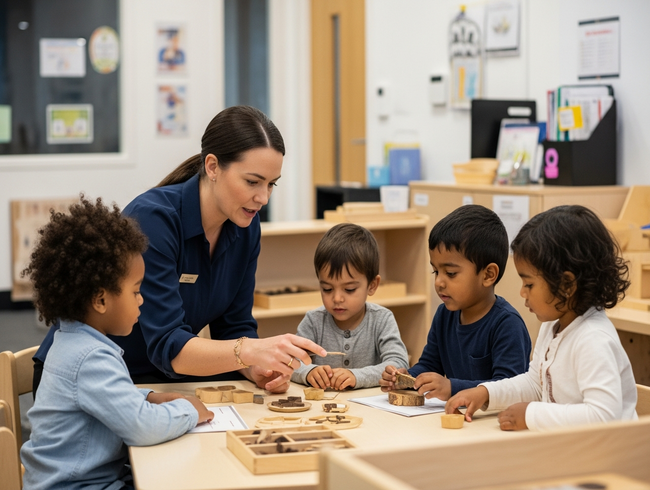
When early childhood educators implement the EYLF effectively, they’re not simply supervising children at play. They’re conducting sophisticated educational practice that recognises play as the vehicle through which children naturally learn best. Every interaction becomes an opportunity to extend thinking, build vocabulary, strengthen social skills, and develop emotional intelligence.
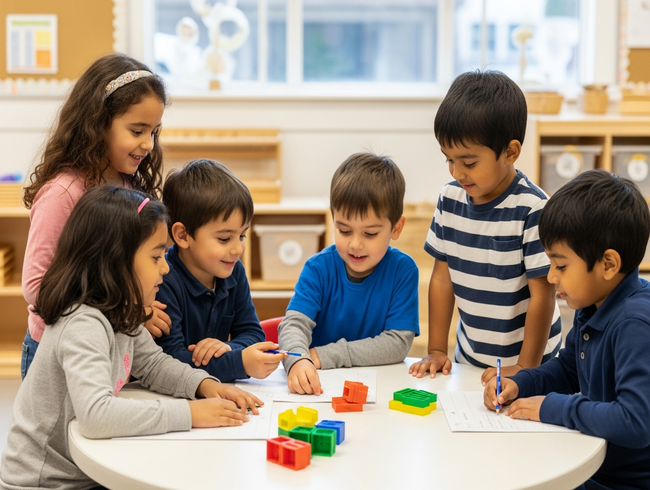
In my experience observing thousands of children over 15 years, those who experience high-quality play-based programs enter primary school with advantages that extend far beyond academic preparedness. They demonstrate resilience when facing challenges, creativity in problem-solving, and the social competence needed to thrive in collaborative learning environments. These are the skills that predict lifelong success, not just academic achievement in early primary years.
To experience how our play-based approach creates these lasting foundations for your child’s development, Book a Tour and Experience the True Maple Difference. Contact us today at 07 5476 0176 or to see firsthand how quality early childhood education through play builds the confidence and capabilities your child needs for lifelong learning success.