
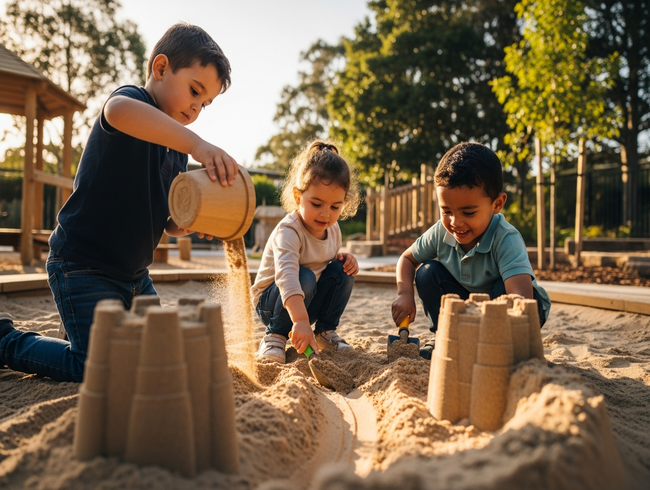
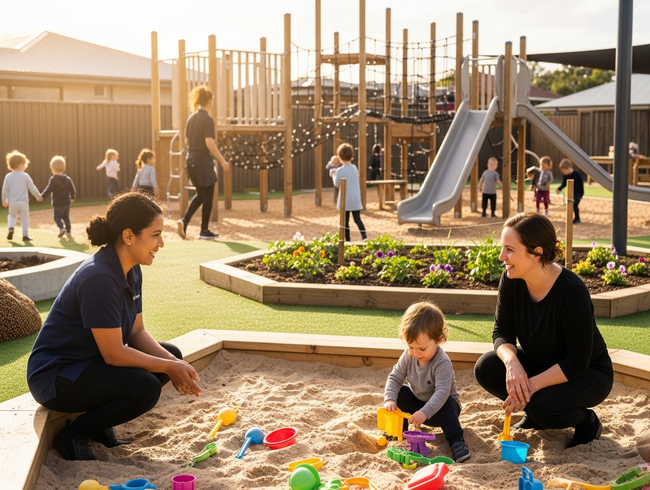
As a nature play advocate, I’m often asked what the most valuable piece of equipment in our outdoor classroom is. It isn’t the climbing frame or the shiny new trikes. It’s the humble sandpit—a space where children aren’t just building castles, they’re building the very foundations of who they will become. I see the hesitation on some parents’ faces; they worry about the mess, the occasional handful of sand thrown in frustration, or whether this simple activity holds any real ‘academic’ value. What most people don’t realise is that the incredible sandpit play benefits extend far beyond simple fun. It’s a dynamic environment where the most complex and vital human skills are forged.
Our philosophy is that the environment is the third teacher, and the sandpit is one of its most profound classrooms. It’s here that we see children grapple with big emotions, learn the delicate dance of social negotiation, and conduct their very first scientific experiments. For parents concerned about their child’s emotional regulation or their ability to make friends, this square of earth and sand offers more targeted learning opportunities than any worksheet ever could. Over the years, I have seen it transform timid children into confident leaders and soothe anxious minds into a state of focused calm. In this article, we’ll dig deeper into the three worlds your child builds every time they step into the sandpit: the sensory world that grounds them, the social world that connects them, and the cognitive world that challenges them.
The Sandpit as a Sensory Sanctuary: Grounding Anxious Minds
If you look closely at how a child interacts with sand, you’ll notice it’s an entirely physical experience. The coolness of the sand on a warm day, the satisfying weight of a full bucket, the mesmerising way it flows through their fingers—this is not just play; it’s a deep, sensory conversation with the natural world. For a young child whose nervous system is still developing, this tactile input is incredibly powerful. It’s grounding. It’s regulating. It’s a sensory sanctuary.
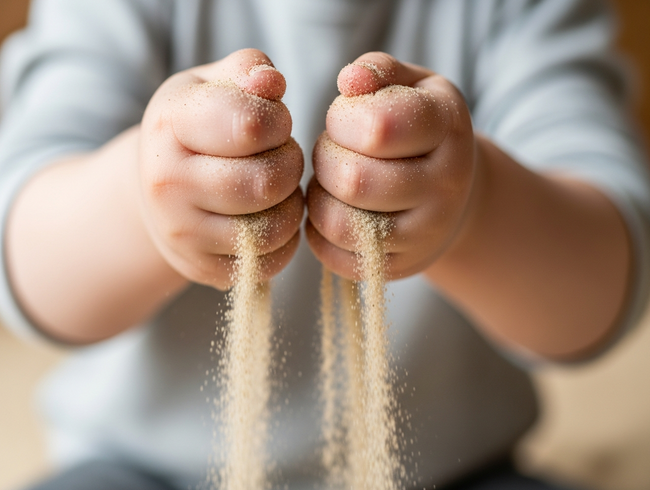
From a scientific perspective, this makes perfect sense. The repetitive, rhythmic actions of digging, pouring, and sifting provide what’s known as proprioceptive and tactile feedback. This feedback helps to organise the brain and calm the body’s stress-response system. It’s a natural tool for processing the ‘big emotions’ that can so easily overwhelm a child, from separation anxiety at drop-off to frustration over a block tower that’s just toppled over.
As a nature play specialist, I’ve seen this happen countless times. I remember one little boy, Leo, who often found morning drop-offs very difficult. He would arrive feeling tense, his body rigid with anxiety. Instead of pressuring him to join a structured activity, his educator would gently guide him towards the sandpit. She wouldn’t say much, perhaps just handing him a scoop and sitting quietly nearby. Within minutes, you could see the change. As Leo focused on filling a truck, his shoulders would relax. His breathing would deepen. The simple, predictable nature of the sand provided the safety and control he needed to regulate his emotions and feel ready to face the day. This isn’t just a nice idea; it’s a core part of the Early Years Learning Framework (EYLF) Outcome 3: ‘Children have a strong sense of wellbeing.’ By providing these natural tools for self-soothing, we empower children to understand and manage their own emotional worlds.
Once a child feels safe and grounded, the sandpit naturally becomes the perfect place to begin exploring their social world.
The Social Blueprint: Building Empathy, One Scoop at a Time
The sandpit is often the epicentre of a playground’s social life. It’s a space of shared purpose, where grand construction projects are imagined and alliances are formed. It is also, inevitably, a space where conflict arises. Two children want the same shovel. One child accidentally flattens another’s carefully constructed road. To a parent, these moments can be stressful. The fear is that their child will be labelled as ‘the one who doesn’t share’ or that conflict will be handled with punitive measures like time-out.
The sandpit is a social laboratory where conflicts over buckets and space are not problems to be punished, but opportunities to be coached.
This is where our philosophy of compassionate guidance comes into play. We see these small conflicts not as behavioural problems, but as crucial learning opportunities for social emotional learning. Let me give you an example. Just last week, I watched as two four-year-olds, Mia and Chloe, both made a grab for the only large red bucket. Tears were imminent. A less experienced educator might have simply taken the bucket away or forced one child to give it up. Instead, our educator knelt down to their level. “I can see you both really want to use the red bucket,” she said calmly, validating both of their feelings. “It’s a fantastic bucket for carrying lots of sand. We have a problem here. How can we solve it so you can both use it?”
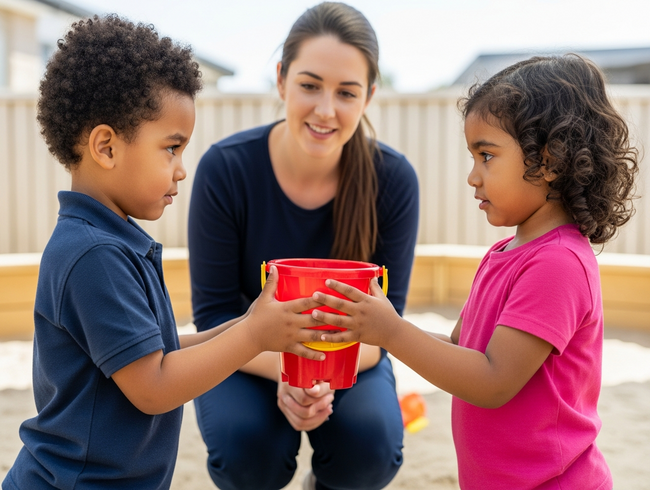
Immediately, the dynamic shifted from conflict to collaboration. Mia suggested, “I can use it first, then Chloe.” The educator prompted further, “That’s one idea. Chloe, what do you think? How long is a turn?” They negotiated that a turn would be five scoops. They counted together. When the turn was over, Mia handed the bucket to Chloe, and the educator praised her for being a great problem-solver and for keeping her promise. In that five-minute interaction, those children practised negotiation, empathy, turn-taking, and delayed gratification—all foundational skills for building resilience in children. This directly supports EYLF Outcome 1 (‘Children have a strong sense of identity’) and Outcome 2 (‘Children are connected with and contribute to their world’). They are learning not just to play alongside each other, but to truly collaborate and contribute to a shared world.
This collaborative spirit not only builds friendships, it also fuels the complex problem-solving that turns the sandpit into a child’s first science lab.
The Earth’s First Laboratory: Fostering Lifelong Inquiry
This is where my botanist’s lens gets truly excited. A child mixing sand and water is not just making mud pies; they are a chemist exploring viscosity and saturation points. A child trying to build a tunnel that won’t collapse is an engineer grappling with structural integrity and gravity. A group of children deciding how to build a moat that connects to a central castle are project managers learning communication, planning, and cognitive flexibility. The sandpit is the earth’s first and best laboratory, and it’s a critical space for fostering the skills of lifelong inquiry.
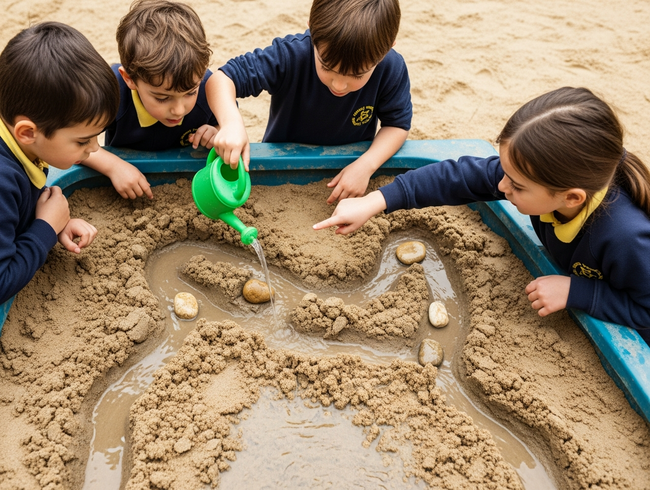
At True Maple, our entire curriculum is built around teaching children the art of learning, not just rote memorisation of facts. We nurture the natural curiosity that drives a child to ask, “What happens if I add more water?” or “Why does the dry sand slide down the hill but the wet sand sticks?” This type of hands-on, inquiry-based learning is directly aligned with EYLF Outcome 4: ‘Children are confident and involved learners.’ They are developing hypotheses, testing theories, and learning from their ‘failures’—a collapsed wall isn’t a mistake, it’s simply new data for the next attempt.
This innate drive to experiment is exactly what we nurture across our entire centre. What most people don’t realise is the direct link between this kind of play and higher-order thinking. The cognitive flexibility a child develops when they have to abandon one sandcastle design and negotiate a new one with a friend is the very same mental skill we enhance in our Mandarin bilingual program. The ability to switch between materials in the sandpit—from wet to dry, from building to digging—strengthens the neural pathways that allow them to switch between languages and conceptual frameworks with greater ease. This kind of child development is holistic; the problem-solving skills learned in the sand become the foundation for critical thinking in all other areas of learning.
It’s clear that from this simple box of sand, the essential skills for a well-rounded, capable future take root.
More Than a Box of Sand: Your Child’s World in the Making
So, when we look at the humble sandpit, we see far more than a place to play. We see a powerful tool for emotional regulation, a sensory sanctuary that calms and centres a child’s busy mind. We see a guided space for mastering complex social skills, a social blueprint where empathy, negotiation, and collaboration are actively coached. And we see a rich environment for developing cognitive abilities, an earth laboratory where the foundations of scientific inquiry and critical thinking are laid, one scoop at a time.
Children in the sandpit are building much more than castles. They are constructing an understanding of their own emotions. They are building the framework for lasting friendships. They are creating a deep, intrinsic love for learning and discovery that will serve them for the rest of their lives.
The next time you see your child in a sandpit, I invite you to look closer. What problems are they solving? What social negotiations are they navigating? What theories are they testing? You might just be fascinated by the intricate world they are building.
Ready to see how our child-led, inquiry-based philosophy delivers results? To see our approach in action, we invite you to Book a Tour of our Springvale centre. Contact True Maple Bilingual Early Learning Centre today at 03 7504 3524 or to arrange your visit.