
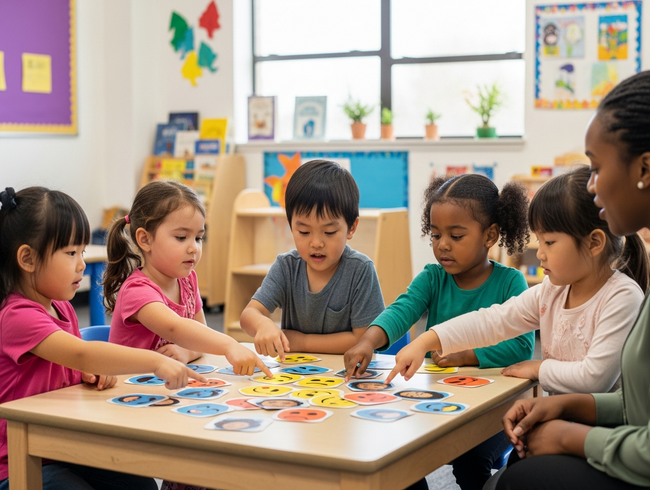
As an Inclusion Specialist with over 15 years in early childhood education, I’ve seen too many beautiful, sensitive children labelled as ‘challenging’ simply because adults didn’t understand their unique way of expressing emotions. Every child – regardless of their temperament, background, or abilities – can develop emotional literacy when we use the right approach.
The Problem: Why Traditional Emotional Vocabulary Building Fails Many Children
Picture this: Three-year-old Aiden melts down every morning during drop-off, but his little sister Emma waves goodbye happily. Traditional approaches might label Aiden as “difficult” whilst praising Emma’s “good behaviour.” But what if Aiden simply processes separation differently and needs emotional language that honours his experience?
One of the key principles of inclusion is recognising that children’s emotional expressions are influenced by their cultural background, individual temperament, and developmental pathway. Yet most emotional vocabulary approaches use a one-size-fits-all method that ignores these critical differences.
Research shows that children with strong emotional literacy are 11% more likely to succeed academically and demonstrate significantly better social relationships. However, when we force children to express emotions in ways that don’t match their natural communication style or cultural background, we inadvertently create barriers to this crucial development.
The Overview: What You’ll Accomplish and What You Need to Know
You’ll learn three adaptable approaches that honour every child’s unique emotional expression style: culturally inclusive vocabulary building that respects your family’s background, storytelling with visual aids that support different learning preferences, and everyday conversation techniques that feel natural rather than forced.
This guide works whether your child is highly verbal, prefers non-verbal communication, is learning multiple languages, or has sensory sensitivities. The key prerequisite isn’t special training – it’s your willingness to observe your child’s natural patterns and follow their lead.
Every child learns differently, and our goal is to create a flexible environment that honours that. Success might look like your quiet child using one new emotion word, or your energetic child learning to identify feelings before big reactions occur.
Materials and Tools: Simple Items for Maximum Impact
You’ll need these accessible materials, easily adapted to your child’s interests and cultural background:
- Diverse children’s books featuring emotional themes with characters from various cultures and abilities
- Visual emotion supports – cards, feeling faces, or charts (purchased or homemade)
- Feelings documentation – a simple journal, chart, or photo collection
- Everyday household items for emotional play – mirrors, stuffed animals, dress-up clothes
Recommended books that celebrate diversity:
- The Way I Feel by Janan Cain (includes children with different abilities)
- My Mixed Emotions by DK Publishing (features diverse families)
- The Feelings Book by Todd Parr (includes various family structures)
Remember, materials should reflect your child’s world – if your family speaks multiple languages, include emotion words in both. If your child connects with certain characters or themes, prioritise those interests.
Step 1: Observe and Honour Your Child’s Current Emotional Expression Style
You’ll spend 3-5 days simply watching how your child naturally communicates emotions without trying to change anything. This observation phase reveals your child’s existing strengths and preferred communication patterns, giving you the foundation for personalised emotional vocabulary building.
Daily observation tasks:
- Notice your child’s body language during different emotional states
- Listen for emotion words they already use (including made-up ones!)
- Identify what triggers big feelings and how they recover
- Observe cultural or family emotion patterns they’ve absorbed
Estimated time: 5-10 minutes of focused observation daily
Pro Tip: In many cultures, emotional expression varies significantly from Western norms. A child who doesn’t make eye contact when upset isn’t being defiant – they might be showing respect or processing internally. Honour these cultural patterns rather than trying to change them.

Step 2: Create Your Child’s Personalised Emotion Word Bank
You’ll build a vocabulary list based on your observations, incorporating words from your family’s cultural background alongside your child’s natural expressions. Personalisation matters because children connect more deeply with familiar concepts and language that reflects their lived experience.
Word bank building tasks:
- List the emotions your child experiences most frequently
- Add emotion words from your family’s cultural or linguistic background
- Include physical sensation words your child uses (“my tummy feels funny”)
- Document your child’s unique expressions (“I feel purple” might mean confused)
Estimated time: 20-30 minutes for initial creation, with ongoing additions
Common Mistake: Forcing sophisticated adult emotion words like “frustrated” or “disappointed” on young children. Start with their natural language and gradually expand – “mad” is perfectly valid and more authentic than “irritated” for a four-year-old.
Step 3: Introduce Emotions Through Culturally Inclusive Stories
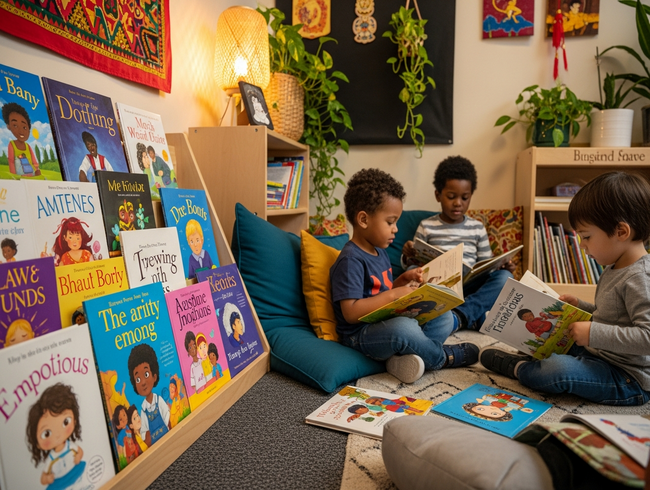
You’ll use diverse books to explore emotions safely, ensuring your child sees families and situations that reflect their world. Stories provide emotional exploration without pressure because children can discuss characters’ feelings before connecting to their own experiences.
Story-based emotion building:
- Choose books featuring characters from various cultures, family structures, and abilities
- Ask open-ended questions: “How do you think Maya felt when…?”
- Connect story emotions to real life: “Remember when you felt worried like the character?”
- Create your own stories using your child’s experiences and cultural background
Estimated time: 15-20 minutes per reading session
Pro Tip: If your family is multilingual, explore emotion words in both languages. Many emotions have cultural nuances that don’t translate directly – honour this richness by teaching both versions.
Step 4: Build Visual Supports That Reflect Your Child’s World
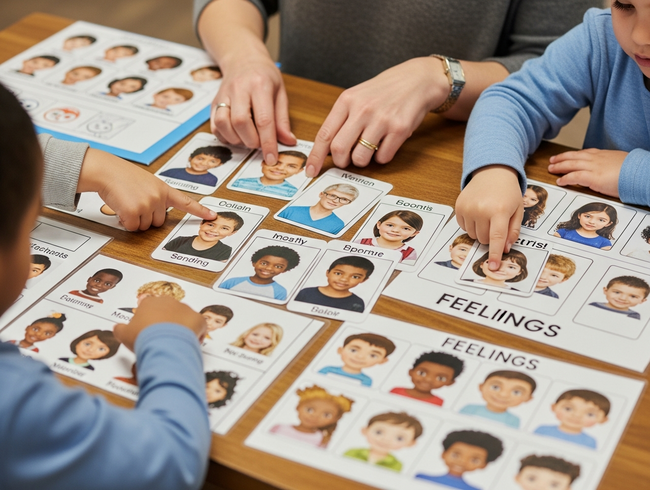
You’ll create or adapt emotion visuals that represent diverse people and match your child’s communication preferences. Visual supports work because they accommodate different learning styles and provide concrete references for abstract emotional concepts.
Visual support creation:
- Source emotion cards featuring diverse faces and abilities (avoid only cartoon representations)
- Create a feelings chart together, using photos of your child showing different emotions
- Include family photos showing various emotional states
- Adapt visuals for your child’s needs (larger images for visual processing differences, fewer choices for sensory sensitivities)
Estimated time: 30-45 minutes for initial setup
Common Mistake: Using only cartoon faces or single-race emotion cards. Children need to see emotional expression across different cultures, ages, and abilities to understand that everyone experiences and shows feelings differently.
Step 5: Practice Emotional Conversations During Daily Routines
You’ll weave emotional vocabulary naturally into meals, bedtime, transitions, and play without creating pressure. Routine integration works because it normalises emotional expression as part of everyday life rather than something that only happens during “teaching moments.”
Daily routine integration:
- During meals: “I notice you’re eating slowly. Are you feeling tired or maybe thinking about something?”
- At bedtime: “What was a happy moment from today? Any worried feelings before sleep?”
- During transitions: “Moving to a new activity can feel exciting or maybe a bit overwhelming.”
- During play: “Your teddy looks sad. What do you think would help them feel better?”
Estimated time: Ongoing throughout your day
Pro Tip: Follow your child’s communication pace and preferred style. Some children need processing time before answering emotion questions, whilst others respond immediately. Neither approach is wrong – adapt your timing to match their needs.

Step 6: Adapt Your Approach for Your Child’s Unique Communication Style
You’ll modify these techniques based on your child’s individual needs, whether they’re non-verbal, highly verbal, learning multiple languages, or have different sensory preferences. Adaptation is crucial because every child’s pathway to emotional literacy reflects their unique strengths and challenges.
Adaptation strategies:
- For non-verbal communicators: Use gesture, pointing to emotion cards, or acting out feelings
- For highly verbal children: Encourage detailed emotion descriptions and feeling stories
- For multilingual learners: Practice emotion words in both languages, noting cultural differences
- For sensory-sensitive children: Use fewer visual choices, quieter discussion times, or movement-based emotion expression
Ongoing observation and adjustment: Notice what works and what doesn’t, celebrating small progress consistently.
We partner closely with families and allied health professionals to ensure every strategy honours your child’s developmental journey whilst building genuine emotional understanding.
Common Mistakes to Avoid
Forcing specific emotion words: Insisting your child say “frustrated” when they naturally say “mad” creates unnecessary barriers to emotional expression.
Ignoring cultural differences: Expecting children to make eye contact during emotional conversations when their cultural background teaches that this shows disrespect to authority figures.
Demanding immediate compliance: Asking “use your words” when a child is overwhelmed, rather than first helping them regulate and feel safe.
Using shame or pressure: Saying things like “big kids don’t cry” or “you’re being too sensitive” shuts down emotional development.
Comparing emotional development: Expecting your quiet child to express emotions like your friend’s outgoing child ignores their individual temperament and processing style.
To learn more about our comprehensive emotional literacy approach and our dedication to celebrating every child’s unique way of learning and expressing themselves, contact True Maple Bilingual Early Learning Centre at 03 7504 3524 or gary@contentfirst.com.au.